Who is behind CrowdHive?
- Who is behind CrowdHive?
- Is CrowdHive regulated?
- What exactly do you own?
- Where is your money kept?
- What protects you if a borrower stops paying?
- What happens if CrowdHive itself goes bust?
- Can you get your money out early?
- How does the protection compare with other platforms?
- Is CrowdHive a scam?
- What is still unknown?
- FAQ
Is CrowdHive safe? It is a registered Swiss company with a written set of contracts, but it is not a bank, it is not directly supervised by FINMA, and it is not open yet. Collateral and a reserve fund stand behind the loans. No guarantee or compensation scheme does. If the operator itself fails, money waiting on your account has no priority.
The answer depends on which risk you mean. The company and its contracts can be checked, and we went through them clause by clause1. How its loans will perform cannot be checked yet, because the platform has not funded any4.
Who is behind CrowdHive?
CrowdHive is run by BellaVista Invest One AG, a Swiss company registered in Zug. The same company signs every contract with investors and borrowers, and it appears in the General Terms, the claim purchase agreement and the privacy policy.
| Legal name | BellaVista Invest One AG |
| Swiss company number (UID) | CHE-373.552.596 |
| Address | Aegeristrasse 64, 6300 Zug, Switzerland |
| CEO | Alena Yudina |
| Law and courts | Swiss law, courts of Zug1 |
| Auditor | To be appointed before launch6 |
Three things are not public yet: who owns the company, who else is on the team, and which audit firm will check the books. The help centre says an independent Swiss auditor will be named before launch. You can look up the company yourself in Zefix, the Swiss commercial register, by searching for the UID above.
Is CrowdHive regulated?
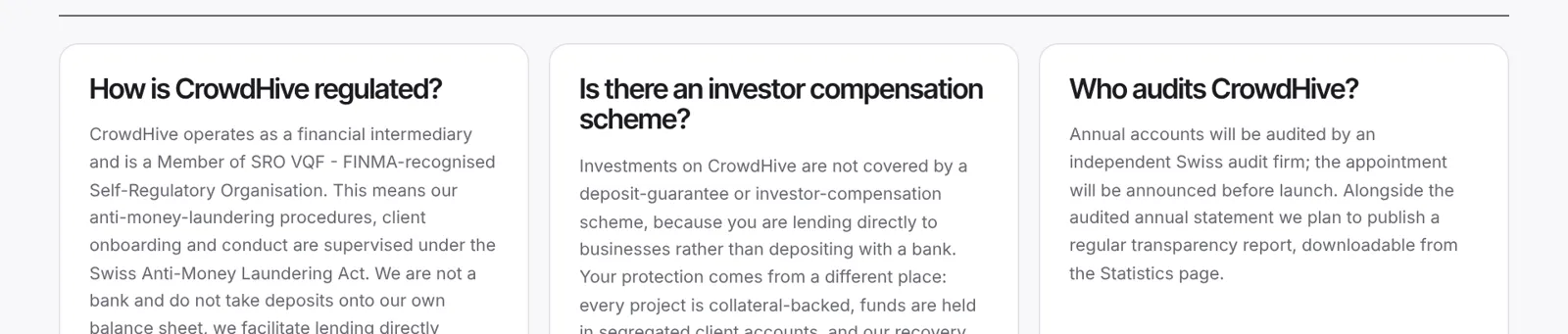
Partly. The General Terms say BellaVista is a member of VQF, a self-regulatory organisation that supervises firms under Swiss anti-money-laundering law. It is not directly supervised by FINMA, it is not a bank, and investor money is not covered by esisuisse, the Swiss deposit protection scheme1.
So if you are asking “is CrowdHive regulated by FINMA?”, the answer is no. FINMA approves the self-regulatory bodies, and VQF in turn supervises its members on money-laundering rules.
What SRO VQF membership does and does not cover
VQF checks that a member knows its customers, verifies where money comes from and reports suspicious transactions. That is why you go through an identity check before investing.
VQF does not assess the loans, set interest rates or check that a project is sound. It does not hold investor money and does not pay compensation if a borrower defaults.
The platform also relies on an exemption in the Swiss Banking Ordinance, article 5(3)(c). In plain terms, money passing through a settlement account on the way to a loan does not count as a bank deposit. The terms add that the service is not a financial service under the Swiss FinSA and FinIA acts.
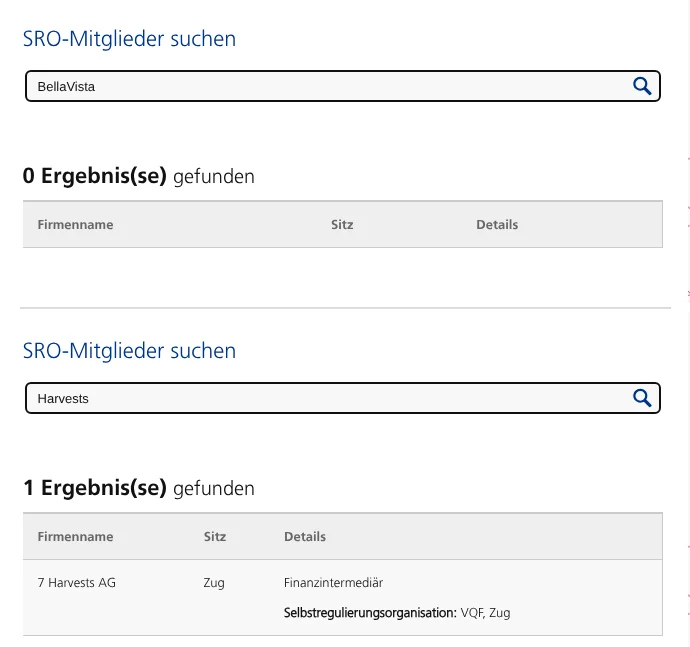
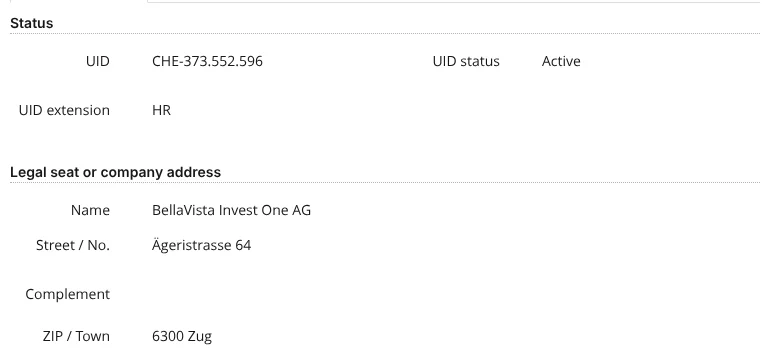
We checked both on 20 November 2026. The Swiss UID register lists BellaVista Invest One AG as an active company at Ägeristrasse 64, Zug7. FINMA’s public search of SRO members returned no entry for BellaVista Invest One AG, under its name or its UID. The same search does list 7 Harvests AG, the operator with the same Swiss set-up, as a VQF member8.
FINMA says its data can lag by two to five working days and carries no guarantee of completeness. So this is not proof that the membership is missing. It does mean the VQF claim stays “stated” in our tracker until it appears in a public register. You can repeat the search yourself on finma.ch.
What exactly do you own?
You own a share of a loan claim. BellaVista lends to the borrower and then sells and assigns to you a part of its right to be repaid, under the Claim Purchase and Assignment Agreement. The claims are ordinary receivables under Swiss law, not securities, and you do not get shares in the borrower2.
The purchase only becomes binding when the project collects its full target amount. If it falls short within the offer period, which is normally 30 days, the agreement never takes effect and your money returns to your available balance.
In practice this means two things. You earn from the borrower’s payments, not from the platform’s profits. And as a creditor you rank where the loan agreement puts you. You cannot act on your own, because BellaVista acts for all investors together.
Where is your money kept?
On a separate account. The General Terms say investor funds in francs and euros are kept apart from BellaVista’s operating money. The bank holding that account is not named in the documents we have1.
You pay in by bank transfer from an account in your own name. Withdrawals go only back to that verified account and usually arrive within one business day6.
Money should not sit idle for long. If cash stays uninvested for 30 days, or repayments are not withdrawn within 60 days, the platform may send it back to your bank account. That limits how much is exposed at any time to the risk described in the next sections. The withdrawals page covers the limits and timing.
What protects you if a borrower stops paying?
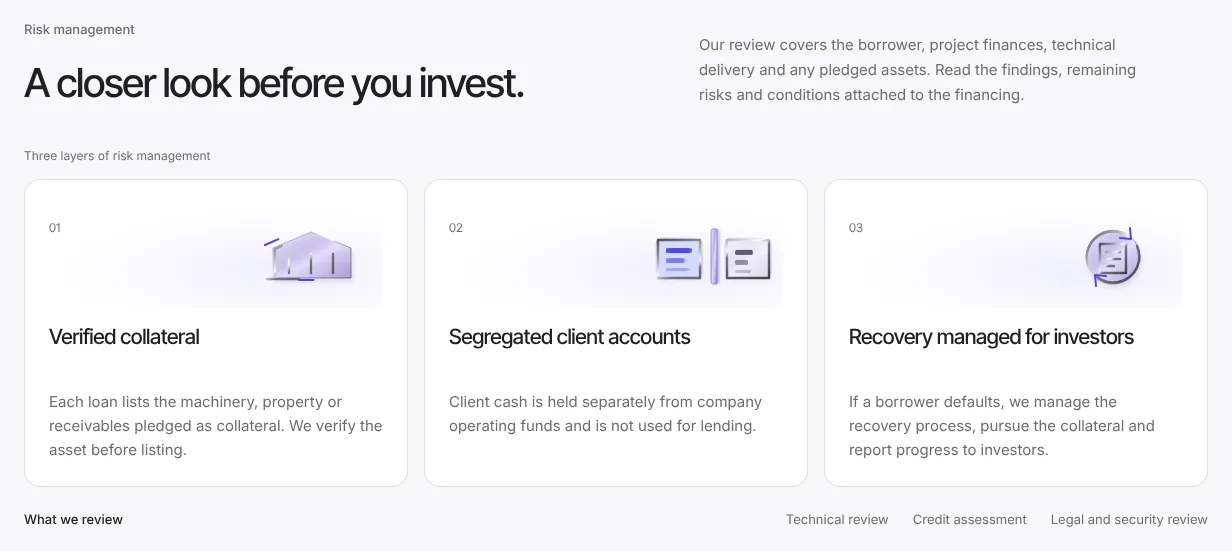
Collateral and a reserve fund, but neither is a guarantee. The contracts describe a fixed sequence of steps when a payment is late1:
The reserve fund is filled with a share of every funded loan. The terms say plainly that it is neither insurance nor a guarantee: it pays only while it has money, and it does not cover your principal.
BellaVista’s duty is to try its best to collect, not to repay you. It does not take on the borrower’s credit risk10. Whatever it recovers is shared out pro rata in this order:
- Collection costs, plus repayment of anything the reserve fund paid out
- Interest that is due
- Principal
An illustration with round numbers. A borrower owes $900,000 in principal and two months of interest at 17%, which is $25,500. The collateral sells for $700,000 and collection costs $40,000. That leaves $660,000: interest is paid in full, and $634,500 goes to principal. Investors get back about 70% of the principal. If you held 0.1% of this loan, you would receive $25.50 of interest and $634.50 of your $900 principal. In this example the reserve fund paid nothing. Real costs, prices and timing will differ.
What happens if CrowdHive itself goes bust?
Your claims against borrowers are yours, but money on your platform account is not protected. The General Terms state that if BellaVista becomes insolvent, investor funds on the account have no privilege under Swiss bankruptcy law1.
The loans themselves were assigned to you, so they should stay outside the operator’s estate. Someone still has to collect the payments. The Loan Agreement allows BellaVista to be replaced as paying and collection agent by a licensed Swiss bank if it resigns or becomes insolvent9. The wording says the bank “may” take over. That gives a way to continue. It does not say any bank has agreed to do it.
What we do not know: whether such a bank has been lined up, and how long a handover would take. Until that is clear, the cash on your account is the part most exposed to the operator, which is a reason not to leave large balances idle.
Can you get your money out early?
Usually not. Your money stays in the loan for its full 8 to 12 months, and the secondary market will only come after a regulatory review6. The withdrawals page covers every case in which money can come back early.
How does the protection compare with other platforms?
Set against licensed lenders, CrowdHive offers the least protection if the platform itself fails, and about the same as the others if a borrower does.
| Platform | Licence | If the platform fails | If a borrower fails |
|---|---|---|---|
| CrowdHive | None; VQF for anti-money-laundering only | No compensation scheme | Collateral; reserve fund for interest |
| 7Harvests | None; VQF for anti-money-laundering only | No compensation scheme | Double buyback, collateral on some loans |
| InSoil Finance | EU crowdfunding licence | No compensation scheme | Mortgages and pledges |
| Debitum | EU investment firm | Up to €20,000 | Pledges, mortgages; buyback on some notes |
| Mintos | EU investment firm | Up to €20,000 | 60-day buyback on many loans |
The €20,000 schemes pay out only if the investment firm itself fails to return your assets. None of them covers a loan that goes bad. The full comparison is on the alternatives page.
Is CrowdHive a scam?
We found none of the usual signs of one. The company is named and registered, the address and CEO are public, the contracts are written out, and the documents state the risks plainly, including that there is no guarantee. The platform does not promise a fixed income: its 10–17% is a target4. Neither CrowdHive nor BellaVista appears on FINMA’s warning list of possibly unauthorised providers11.
What it lacks is a track record. No loan has been funded, no interest has been paid, the auditor is not yet named, and the default statistics are still to come5. You can check whether the paperwork holds together, as this page does. Whether the loans get repaid will only be known after the first ones mature. If CrowdHive is legit in practice, that is where it will show.
What is still unknown?
Six items on our tracker are either stated only on the website or due at launch:
- Membership of VQF, so far stated by the operator and not yet confirmed in the VQF list
- The four projects and their terms, shown as “coming soon”4
- The secondary market, described in the help centre but held back in the General Terms
- The names of borrowers, collateral and ratings for each project
- Default and recovery statistics
- The name of the auditor
We update the status page when any of these changes, with the date and the source.
FAQ
Is my money insured?
No. Investor money is not covered by esisuisse, the Swiss deposit protection scheme, and the reserve fund is described as neither insurance nor a guarantee.
Is CrowdHive a bank?
No. BellaVista does not take deposits in the banking sense and relies on an exemption in the Swiss Banking Ordinance.
Can I take the borrower to court myself?
No. Investors cannot act against the borrower directly. Collection and legal action go through BellaVista under the Debt Collection Procedure Agreement.